Family offices · Exploring a clinic
7 strategic questions for family offices developing a longevity clinic
Seven decisions for family offices: define the ownership mandate, patient proposition and operating organisation before the next capital commitment.
Published by ZONED · · Updated
A family office may enter longevity through an attractive property, a personal interest in health or a proposal from a founder. Each starting point brings different assumptions. Before commissioning the clinic, the owner needs to establish which business it intends to build, whom it will serve and what evidence would justify proceeding. These seven questions connect that mandate with the organisation and assessments needed to deliver it.

1. What strategic objective should the clinic serve?
An investment team seeking a standalone business, a family adapting an existing property and an owner improving a clinic may use the same word—longevity—while pursuing different objectives. Establish the purpose of ownership and how much involvement the owner expects before those differences reach design, recruitment or launch decisions.
The mandate should explain the proposed format, its relationship to other family interests and the authority to approve commitments. Where family members and project leaders want different things, make the disagreement explicit while the concept can still change.
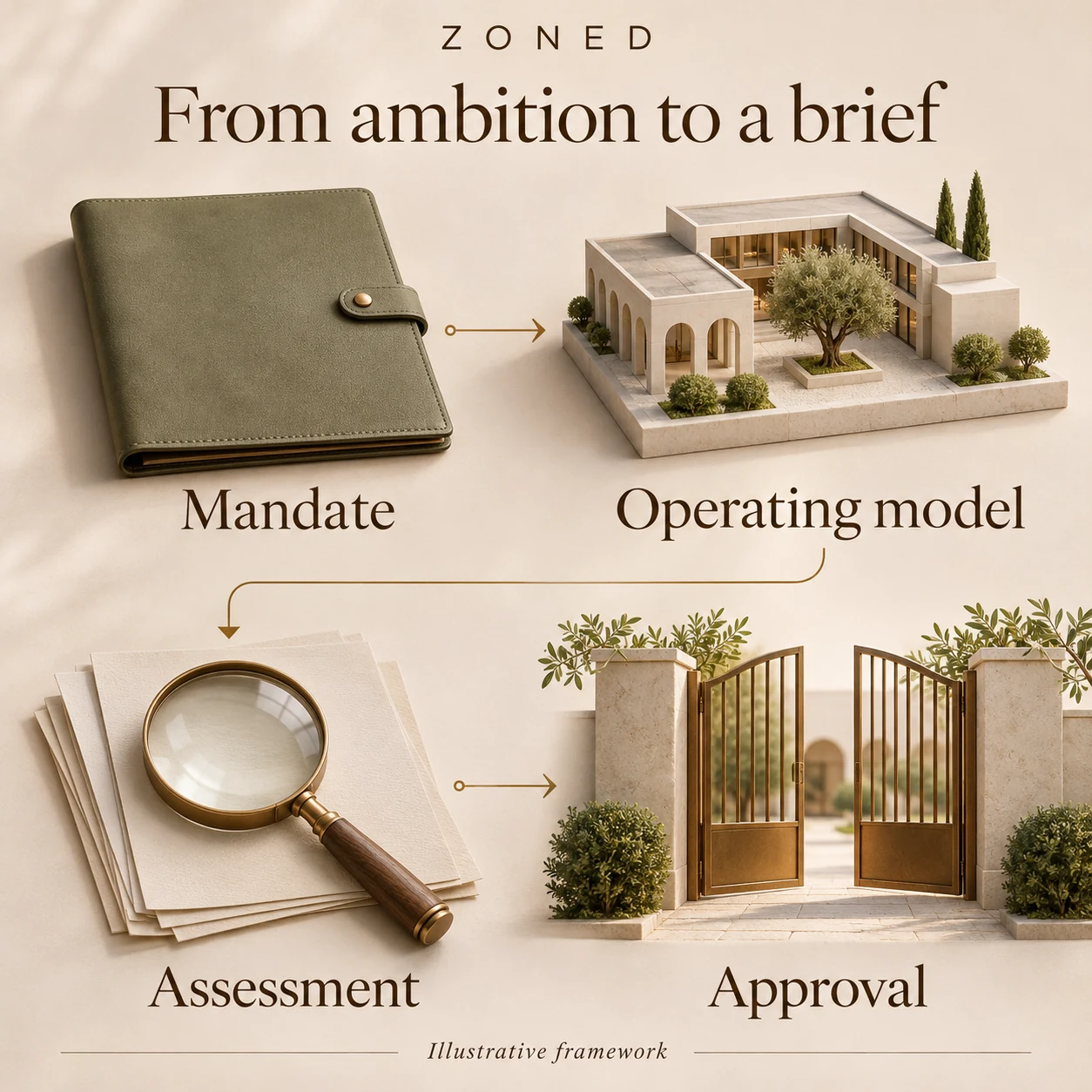
Record the ownership rationale, intended format, current stage and next approval decision in a short mandate.
2. Which clientele and demand assumptions underpin the proposition?
HNW or UHNW describes financial circumstances, not a reason to attend a clinic. Define the intended patient’s location, needs, attendance pattern and existing care relationships. A destination stay, resident membership and appointment-based clinic imply different access and continuity requirements.
This produces a proposition to test. It does not prove demand. Appointed market and financial specialists must assess the assumptions about acquisition, use and willingness to pay for the proposed offer, and identify findings that would change it.
Prepare the patient profile and the demand questions requiring independent assessment. State what remains an assumption.
3. How does the service model translate into operating requirements?
Ask qualified clinical leadership to define how consultation, assessment, care, referral and follow-up would connect. Then translate the proposed service into people, space, equipment and coordination requirements. Keep services awaiting professional assessment distinct from capabilities approved for delivery.
An equipment shortlist may look concrete while the delivery model remains unresolved. Before a purchase progresses, the owner should know which approved service it supports, who can deliver it and what site, staffing and technical requirements follow.
Use a service map to expose the staffing, equipment and property decisions that depend on clinical approval.
4. What governance and management structure will support delivery?
Ownership, clinical leadership, operations and patient coordination need distinct authority and a way to work together. A list of advisers or impressive individual appointments does not explain who resolves a disputed priority, approves a service or owns the next action.
In one anonymised ZONED engagement, an investor’s proposed clinic lacked a concept, team and patient journey. ZONED developed these foundations from scratch. The example illustrates the scope of the work, without establishing financial or clinical outcomes. A service concept needs a delivery organisation and a defined patient journey alongside it.
Assign who advises, delivers and approves each recurring decision. Make unfilled roles and unresolved authority visible.
5. Does the property support the intended operating model?
A property already owned by the family can create momentum before its fit with the clinic has been established. Compare its access, privacy, circulation, rooms and supporting infrastructure with the proposed service. Ask what would have to change in the business to make the asset work.
That comparison informs the brief for architectural, technical and local regulatory specialists. Their suitability and approval findings may change the offer, layout or decision to proceed; ownership and architectural appeal do not settle those questions.
Identify the property findings needed before acquisition, lease or fit-out approval, and appoint the relevant specialists.
6. How will the operational proposition be tested by specialist advisers?
Different assessments answer different questions. Financial and market advisers assess demand, capital requirements, operating costs, utilisation and viability. Clinical, regulatory, architectural and technical specialists assess matters within their remits. Identify the operational inputs each needs and who maintains them.
Findings must return to the concept. If the team structure, property or service changes, the corresponding commercial assumptions also need review. ZONED advises on the operational brief and development priorities; financial feasibility modelling and investment due diligence are outside its confirmed offer.
Agree the inputs, responsible adviser and approval dependency for each assessment. Track changes across workstreams.
7. What evidence is required before the next capital commitment?
Before the next acquisition, lease, design or equipment commitment, identify the finding it depends on and who can approve it. Work may proceed in parallel where dependencies permit, but a target opening date should not stand in for a completed assessment.
The owner needs a practical choice at each review: proceed, revise, investigate further or stop. Keep unresolved assumptions visible so the project can change before they become expensive commitments.
Maintain a decision log recording the commitment, outstanding evidence, responsible parties and owner approval point.
Prepare for an introductory conversation
- The strategic rationale, intended clientele and principal assumptions underlying the proposed clinic.
- The location or property under consideration, current development stage and next material commitment.
- The governance structure, appointed advisers and responsibilities requiring clarification.
- The operational questions for which you seek advisory support. Please exclude patient records and confidential third-party material.