Owners and project teams · Developing a clinic
Define the service offer before selecting equipment
An equipment shortlist is only part of a service decision. Establish the patient need, clinical role, staffing and continuing obligations before committing to a device.
Published by ZONED · · Updated
An equipment proposal makes a clinic concept feel concrete: a named device, a room and an apparent capability. The harder questions concern the service around it. Who is it for, who determines suitability and what must happen before and after its use? Those answers should shape the purchase brief.

Begin with the service the patient will receive
Describe the intended patient’s route into the service: assessment, professional decision, delivery and follow-up. A device may be one requirement within that route. It cannot define the entire offer or establish that the proposed patient needs it.
Qualified clinical leadership must assess the rationale, suitability and governance of the proposed service. ZONED can help connect its operating requirements with the wider offer and patient journey; brand positioning does not replace that clinical assessment.
Translate the offer into operating requirements
The appointment is only the visible part of delivery. Include preparation, coordination, cleaning, maintenance and follow-up when specifying roles, rooms and supporting activities. Each requirement needs an owner and, where applicable, professional assessment.
Use those requirements to test the order of decisions. Equipment selection may depend on the approved service, qualified staffing, the actual site and technical findings. An unresolved dependency belongs in the approval brief rather than in an unstated assumption.
Compare proposals against the service requirement
Compare proposals against the same service requirement. Record what each would need from installation, staffing, training, maintenance, consumables and continuing support. Distinguish supplier statements from findings assessed by the appointed specialists.
Give financial advisers the acquisition and operating assumptions to test in their model. A product comparison can inform their assessment, but does not establish demand, utilisation or viability.
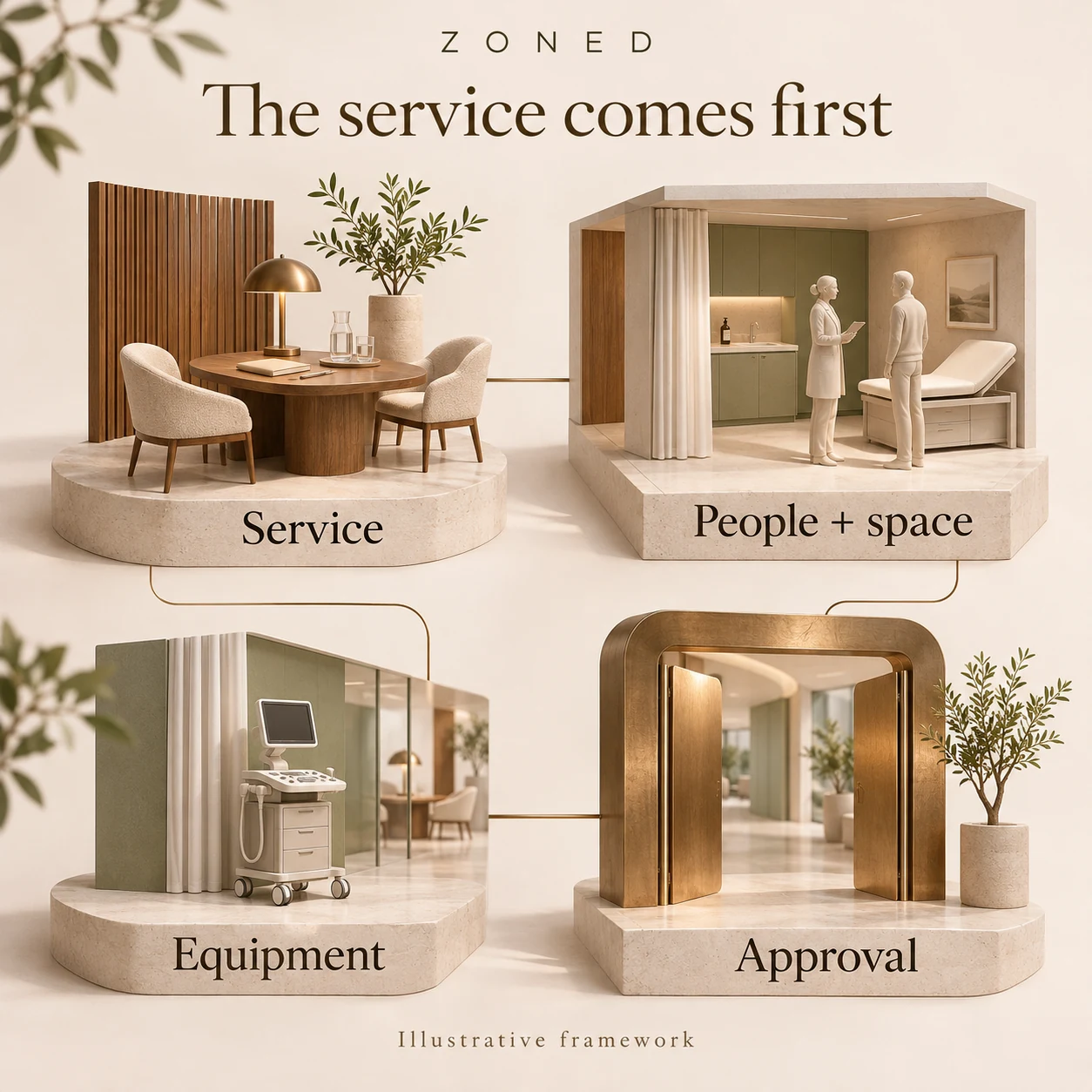
Consider the experience around the treatment
Consider an illustrative patient asking what a result means after the appointment. Who responds, what can they explain and when is a further professional review needed? The offer must account for this work as well as the treatment room.
Map privacy, explanation, scheduling, handover and follow-up into the journey. Check that the enquiry team and clinical team describe the same service boundaries before it enters launch communication.
Sequence approvals before commitments
Bring the service definition, specialist findings, operating requirements and financial assessment to the relevant decision-makers. Record who approves the commitment and which questions must be resolved first. Financial feasibility modelling and investment due diligence remain outside ZONED’s confirmed offer.
Within an agreed scope, ZONED can prepare a service and equipment priorities brief linked to staffing and the patient journey. It is an operational deliverable, not a prescribed treatment list or a recommendation to buy a particular device.