Clinic developers and leadership · Developing a clinic
Privacy and social connection: a design question for premium longevity clinics
A shared lounge or membership community creates choices about privacy, participation and staffing. The clinic needs to make those choices explicit.
Published by ZONED · · Updated
A shared table may be the highlight of one patient’s stay and an unwelcome obligation for another. A premium clinic needs a considered response to both. The development question is how optional social experiences fit around private care: what they provide, how patients choose and what the team must organise when someone prefers to remain private.
This article interprets public-health work through an operational design lens. It does not establish that an exclusive club, shared activity or clinic membership reduces loneliness or improves health.

1. Establish the purpose of any shared experience
WHO’s Commission on Social Connection identifies loneliness and social isolation as public-health concerns and examines responses across individual, community and policy settings. That work establishes a relevant context for considering social needs; it does not validate a particular private-clinic format. [1]
A lounge, event programme or membership identity needs a specific purpose. Hospitality, general education, peer conversation and clinically led group work are different offers. Decide which is intended before using the language of community to describe all of them.
Write a purpose and participant brief for each format. Clinical content or proposed health claims require qualified review.
2. Build meaningful choice into the service
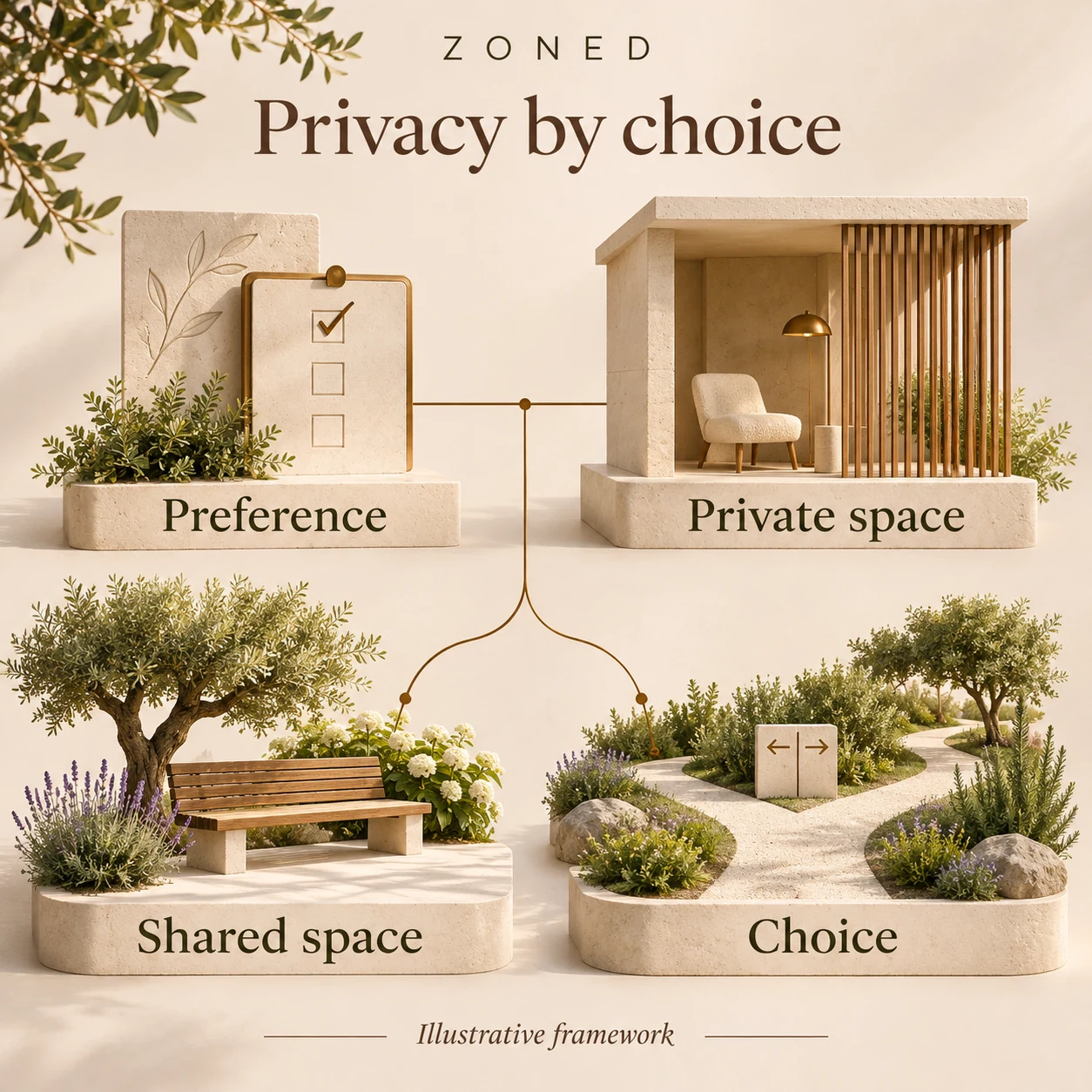
Design the private option at the same time as the shared experience. Can a patient decline a group meal or activity and still receive the service they came for? Do not infer a preference for social contact from spending power, nationality or membership status.
The practical test is whether the clinic can deliver a coherent experience when a patient declines the shared element. Assess alternative scheduling, private formats and communication. The owner should understand what those choices require from the team and what the agreed service scope includes.
Record the options at each touchpoint, who confirms the preference and how staff learn about a change.
3. Translate preferences into spatial relationships
Imagine a patient arriving for a private consultation while an event is taking place. Where do they enter, wait and move next? This illustrative scenario exposes the relationship between shared spaces, circulation and private rooms more clearly than considering each room in isolation.
Physical separation is one design consideration; scheduling and staff coordination are others. A small clinic may need a different response from a destination property. The relevant specialists must assess accessibility, acoustic conditions, circulation and other requirements for the actual setting.
Give architectural and technical advisers a map of intended encounters and privacy needs. Their assessment must establish what the actual property can support.
4. Define staff conduct and information boundaries
An introduction can be welcome; identifying someone as a fellow patient may be unwelcome. The brief should address what staff can disclose about attendance, photographs, guest lists and participation, as well as the handling of clinical records.
Ask the appropriate clinical and information-governance advisers to define the relevant procedures, permissions and communication boundaries. The operational brief should explain how these requirements reach hospitality, coordination and external partners, without suggesting that every participant has agreed to the same level of visibility.
Ask clinical and information-governance advisers to define the rules, then translate them into instructions that hospitality and external partners can use.
5. Match the format to the capability required
A skilled host is not automatically qualified to lead a therapeutic group. Describe what the facilitator will do, what participants are told and how a request for individual advice reaches the appropriate professional. Select capabilities against that remit.
Consider the operational contingencies: an unexpected disclosure, a participant seeking individual advice, or an activity that no longer suits the group. Clinical leadership should determine the boundaries where relevant; management should ensure staff understand the agreed response and escalation route.
Test the arrangements against an unexpected disclosure, a request for individual advice and a facilitator’s absence before offering the format.
6. Evaluate the experience without overstating its effects
Start by asking whether the experience worked as promised. Could patients express a preference? Did staff act on it? Was a private alternative available? Those questions can guide service improvements without implying that participation reduced loneliness or improved health.
Any health-outcome claim requires a separate evidential basis and appropriate professional interpretation. ZONED can help connect the space, team and patient journey within an agreed scope. Appointed specialists retain responsibility for clinical, regulatory, technical and information-governance assessments.
Agree who reviews feedback and approves changes. Ask financial advisers to assess the resources required before adding more formats.
Prepare for an introductory conversation
- The purpose and intended participants for each proposed shared format.
- Private alternatives and how preferences will be recorded and acted on.
- Spatial relationships, information flows and staff responsibilities requiring assessment.
- Review questions that distinguish service experience from health-outcome claims.
Sources and scope
The links below identify source material. ZONED’s operational interpretations are identified in the article; the diagrams support the operational discussion.
- WHO — Commission on Social Connection
Public-health evidence and policy context. It does not establish clinical benefits for a private membership or hospitality programme.