Clinic developers and operators · Developing a clinic
Nutrition as a service model: connecting clinical oversight, hospitality and everyday practice
A dietary theme becomes a clinical service through qualified assessment, reliable delivery and support that fits the patient’s life after the visit.
Published by ZONED · · Updated
A clinic can describe its nutrition philosophy in a sentence. Delivering it may involve a clinician, nutrition professional, kitchen, hospitality team and the patient’s household after departure. For an owner, the critical work is connecting those responsibilities. A menu, an educational experience and individually assessed dietary care are different offers, even when they share the same branding.
An operational planning article, not individual dietary advice. Research is described in its studied population and outcome context. The original diagrams are ZONED’s planning interpretations, not clinical pathways or validated nutrition programmes.

1. Define the service before selecting the dietary narrative
Decide what the patient is buying: general education, hospitality, individual dietary assessment or a defined combination. Each choice changes the people, facilities and follow-up required. A destination stay and an outpatient consultation should not inherit the same delivery model simply because they use the same dietary language.
WHO describes healthy diets through adequacy, balance, moderation and diversity, while recognising variation by individual characteristics and context. That public-health guidance supplies a foundation for discussion; it does not select a personalised regimen or validate a commercial programme. [1]
Write separate descriptions for the educational, hospitality and clinical elements, then have the appointed professionals assess their scope.
2. Keep the research question aligned with the claim
The corrected and republished PREDIMED report examined Mediterranean dietary interventions in older adults at high cardiovascular risk. It reported fewer major cardiovascular events in the intervention groups than the comparison group. The 2018 analysis addressed departures from random assignment identified after the original publication. [2]
Keep that population, intervention and cardiovascular outcome attached to any use of the research. It does not establish lifespan extension from a clinic stay, menu or branded nutrition programme. Clinical reviewers should assess the evidence for the actual proposal before it becomes part of the patient promise.
For every proposed health claim, retain the source, studied population, intervention, measured outcome and professional approval.
3. Connect professional assessment with delivery
Consider an illustrative change to a patient’s agreed dietary plan during a stay. Who approves it, who updates the kitchen instructions and who confirms what is served? That chain needs to be designed before the team has to rely on an informal conversation to connect assessment with delivery.
The operating question is whether those responsibilities connect in practice. Consider how a change in the professional plan reaches the delivery team and how an unresolved question returns to the appropriate person. Staff should understand the boundary between explaining a service and amending individual advice.
Map the handover from assessment to delivery and review. Make clear which staff can explain instructions and which professionals can amend them.
4. Make hospitality requirements explicit
A residential concept needs to translate the intended food offer into sourcing, preparation, service timing and handling of individual requirements. Appointed specialists must assess food safety, allergens and local obligations. An outpatient model may instead need clear arrangements with external providers.
A premium presentation is one part of the experience. The brief should also identify how substitutions, guest requests or changes in availability are managed without leaving staff to interpret clinical instructions beyond their remit. For an outpatient clinic, assess whether partnerships or external provision create equivalent interfaces.
Agree how substitutions, guest requests and supply changes reach the appropriate decision-maker. Give financial advisers the resulting resource assumptions.
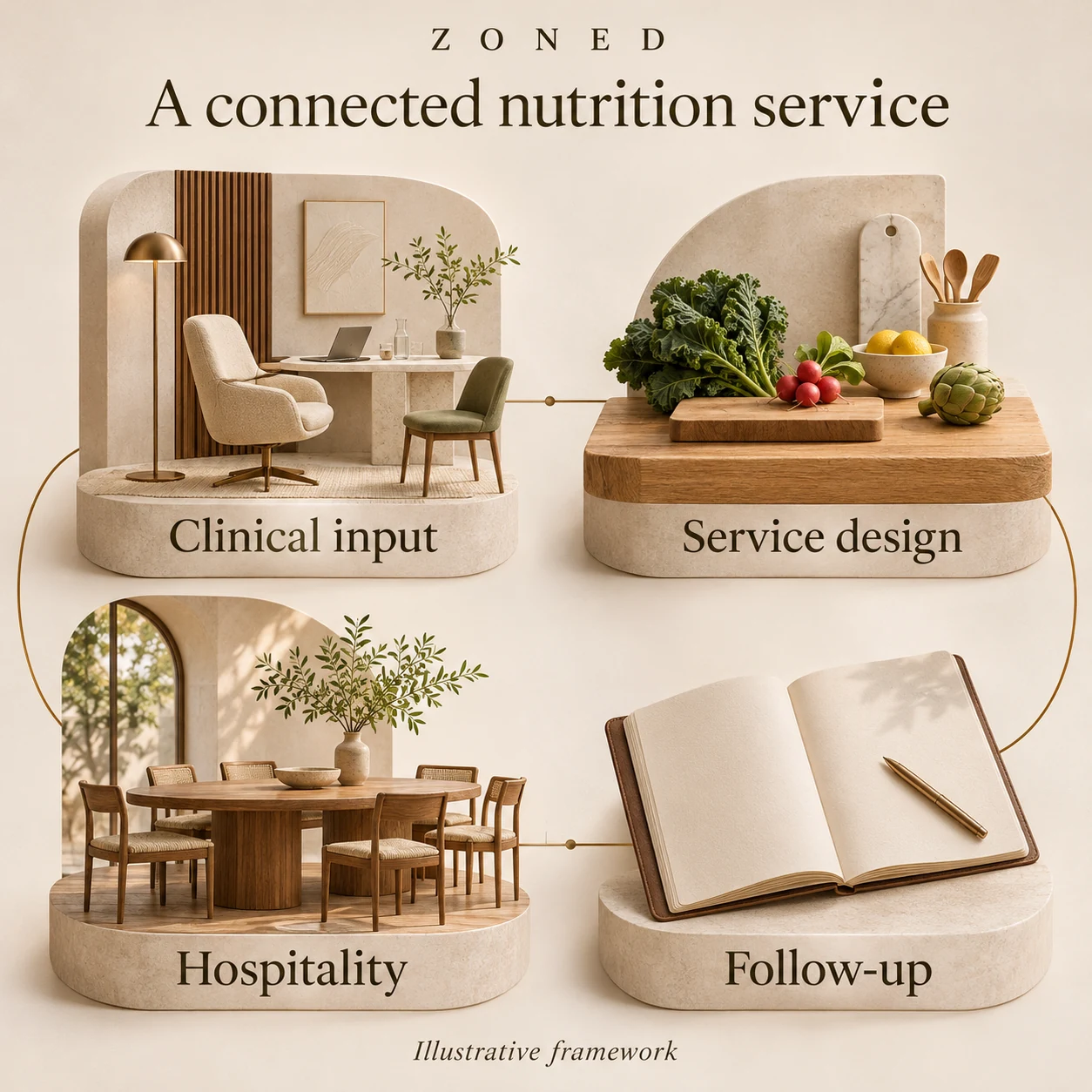
5. Design the transition to everyday practice
The clinic environment ends at departure. The patient may return to frequent travel, household routines or limited access to the food provided during a stay. Qualified professionals need to consider those circumstances when agreeing a plan; the service description needs to explain what support continues.
ZONED’s planning interpretation is to treat that transition as a service-design question. Define who provides agreed educational material, who coordinates a review and where individual clinical questions are directed. Avoid implying that the experience during a stay establishes sustained change afterwards.
State who provides material, coordinates reviews and receives clinical questions after departure. Do not imply that a successful stay establishes sustained change.
6. Review delivery and clinical outcomes on separate terms
A positive dining review and a clinical outcome answer different questions. Management can examine whether the promised offer was available and whether instructions reached the team. Clinical findings need their own assessment, and neither category should be used as a substitute for the other.
ZONED can help connect the service concept, patient journey, hospitality and team requirements. Appointed specialists remain responsible for clinical, technical and regulated delivery assessments. Financial feasibility modelling and investment due diligence are outside ZONED’s confirmed offer.
Use delivery findings to revise the offer or its resourcing before extending it. Record who approves the change and how it reaches the team.
Prepare for an introductory conversation
- The intended clientele and the exact educational, hospitality and clinical services proposed.
- The professional roles, approvals and handovers behind delivery.
- The setting, food-service scope and local specialist assessments required.
- The follow-up promise, operational review questions and evidence for public claims.
Sources and scope
The links below identify source material. ZONED’s operational interpretations are identified in the article; the diagrams support the operational discussion.
- WHO — Healthy diet (2026)
Population-level dietary guidance. It does not replace individual assessment or establish outcomes for a proposed clinic programme.
- Estruch and colleagues — Primary prevention of cardiovascular disease with a Mediterranean diet supplemented with extra-virgin olive oil or nuts, NEJM (2018)
Corrected and republished report, with revised analyses addressing randomisation departures. Its defined high-risk population and cardiovascular endpoints limit the claims that can be drawn here.