Clinic owners and leadership · Improving a clinic
From advice to implementation: the operating requirements of behaviour change
What a clinic must deliver between good advice and everyday action: defined support, capable practitioners and a process for adapting the service.
Published by ZONED · · Updated
A patient leaves a consultation with a plan. A week later, travel, work or family responsibilities may make that plan difficult to follow. If the clinic promises ongoing support, what happens next? This is where a behaviour-change offer becomes an operating commitment: someone must understand the difficulty, provide the agreed support and know when a clinical question needs to return to the responsible practitioner.
An organisational perspective on published behaviour-change guidance. The proposed management frameworks are ZONED’s interpretation. Clinical methods, individual suitability and regulated delivery remain with appropriately qualified professionals.

1. Define the intervention before packaging the service
NICE describes behaviour-change approaches involving agreed objectives, practical planning, monitoring, feedback and support from others. Its guidance also addresses how interventions are specified and evaluated in relation to the people they are intended to serve. [1]
For the owner, the first task is to describe the service a patient will actually receive. A coaching entitlement might mean a scheduled conversation, practical planning or access to an educational resource. Those are different commitments. The name of a membership does not establish which one the clinic is equipped to deliver.
Before packaging the offer, agree its participants, activities, format and review process with the qualified clinical team.
2. Identify the barriers the service intends to address
Information and implementation are different problems. Explaining an agreed recommendation again may not address a patient’s lack of time, access or practical support. In an illustrative travel scenario, the useful operating question is whether the clinic can adapt the support it promised, and who is authorised to make that change.
NICE emphasises tailoring support to individual capability, motivation and physical and social circumstances. Applying that principle to clinic planning means making room for assessment and adaptation, rather than assuming that one standard schedule will suit every participant. [1]
The service brief should identify which practical barriers it can address, what information staff need and when referral or a change of scope is required.
3. Specify practitioner capabilities and supervision
Hiring a coach does not settle the delivery model. Define the activities the role covers, the capabilities those activities require and the point at which a question goes back to clinical leadership. Administrative encouragement, general education and individual clinical recommendations carry different responsibilities.
The owner needs a defensible basis for recruitment, induction and oversight. Ask the appointed professionals to identify qualifications, training and supervision appropriate to the actual activities and jurisdiction. Supplier training on a platform should be assessed separately from competence to deliver the proposed service.
Recruitment and induction should follow that activity specification. Record the supervision arrangement and the limits of each role.
4. Plan for adaptation without losing consistency
Personalisation needs an agreed core. If every practitioner interprets the service differently, management cannot readily tell whether a patient received a deliberate adaptation or missed part of the promised support. Specify what must happen, what can vary and who can authorise that variation.
Consider a sample case in which travel interrupts attendance or a patient’s priorities change. The operational review should establish who contacts the patient, who can amend the professional plan and where the next action becomes visible. These are scenarios for testing the process, not accounts of actual patient outcomes.
Use a sample journey to test how adaptations are agreed and recorded. Treat it as a process exercise, not evidence of patient outcomes.
5. Separate delivery measures from health claims
A completed session tells management that an activity took place. It does not establish that a patient could use the advice or that their health improved. Review delivery, patient experience and clinical outcomes as separate questions, with the relevant professionals defining and interpreting the latter.
A high attendance rate would not, by itself, establish a health benefit. Nor should a favourable testimonial replace an assessment of the service. Agree how operational information, patient experience and clinical findings are considered separately before they inform changes or public communication.
Agree which questions each measure can answer, who reviews it and what additional evidence would be needed before making an outcome claim.
6. Resource the service before extending the promise
Before adding continuing support to a membership, describe the work it creates: practitioner time, coordination, supervision, systems and external-provider involvement. Ask what happens during absence, interrupted attendance or unusually high demand. Give the resulting assumptions to appointed financial advisers to assess; a complete service specification is not a viability conclusion.
ZONED can help connect the service offer, patient journey and team structure within an agreed operational scope. Clinical governance remains with appointed professionals; financial feasibility modelling and investment due diligence remain outside ZONED’s confirmed offer.
Walk through the promised support with the people expected to deliver it. Resolve gaps in time, capability or responsibility before extending the public offer.
Prepare for an introductory conversation
- A specification of the support offered and its intended participants.
- The responsible roles, capability requirements and supervision interfaces.
- Essential delivery components, permitted adaptations and review questions.
- The assumptions appointed financial and clinical advisers need to assess.
Sources and scope
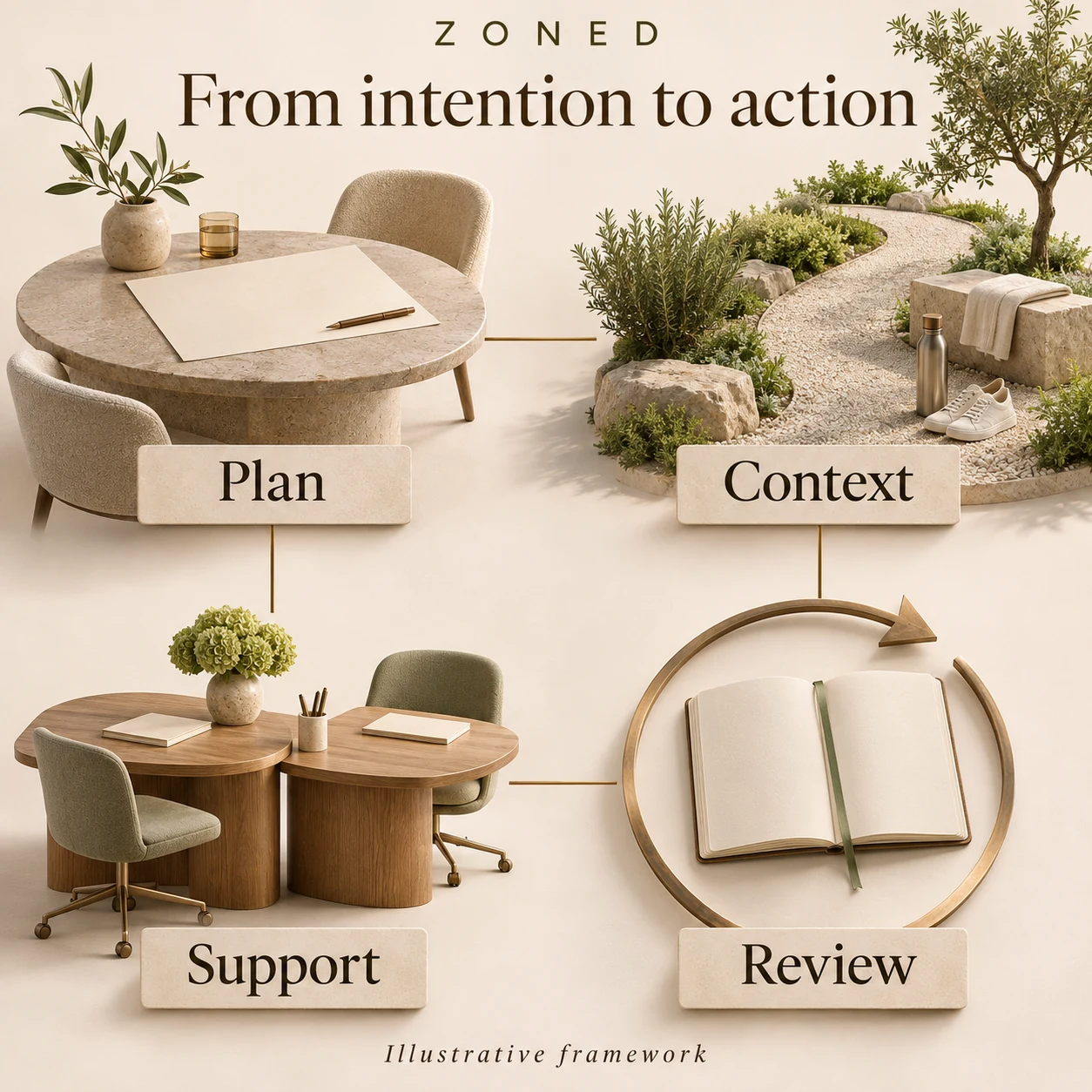
The links below identify source material. ZONED’s operational interpretations are identified in the article; the diagrams support the operational discussion.
- NICE — Behaviour change: individual approaches, PH49
Public-health guidance on intervention design and delivery. ZONED’s staffing, operating and review questions are editorial applications, not a clinical protocol.